
How the most mundane task in healthcare became Montage Health’s biggest win
Read blog


Catholic Health’s CDIO shares how health systems can extend agentic AI beyond the EHR, prioritize by value, and build automation that lasts.
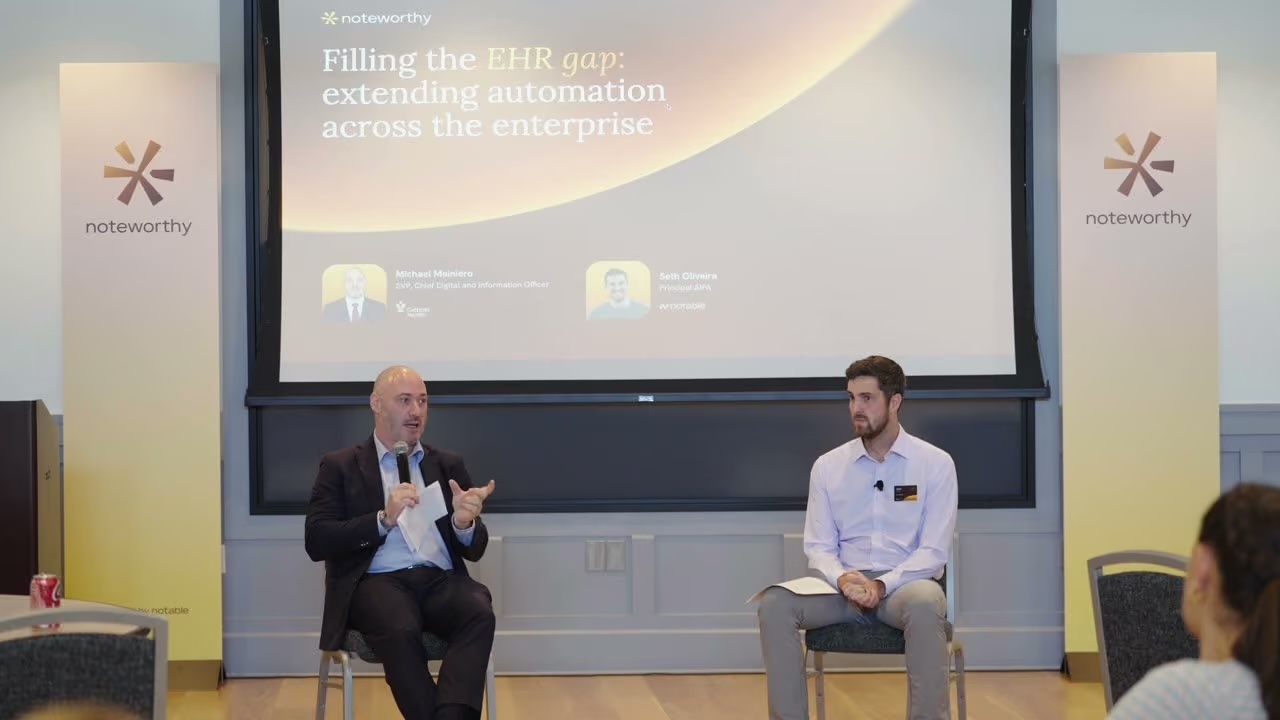
Full session: “Filling the EHR gap: extending automation across the enterprise” with Michael Mainiero, Catholic Health, and Notable’s Seth Oliveira.
summary
Michael Mainiero, Chief Digital Information Officer at Catholic Health, explains how his Epic-first health system uses an AI platform partner to automate work outside the EHR, such as revenue cycle and patient access. He also shares the value-first framework Catholic Health uses to decide which of roughly 600 annual requests get built.
Catholic Health gets about 600 technology requests a year. How does it decide which ones become real, lasting change? In this fireside chat at Noteworthy 2026, Michael Mainiero, Chief Digital Information Officer at Catholic Health, joined Notable’s Seth Oliveira to talk about extending automation across the enterprise, beyond the EHR.
Michael explains how they test every innovation for feasibility, viability and, above all, sustainability, meaning the ability to keep iterating after go-live. He argues that health systems need an agentic AI strategy now. Denials are rising, IT costs keep climbing, and patients have more and more choices. He also says point solutions and digital front door projects alone won’t win over the CFO. The bigger opportunity is in revenue cycle and operational throughput. To get there, Catholic Health pairs Epic with an AI platform partner that can move as fast as it needs to.
Lessons you’ll learn in this session:
Watch the full session for an inside look at how one CDIO is building a scalable, sustainable agentic AI strategy.


Health systems can pair their EHR with an AI platform that works across the systems the EHR doesn’t reach, such as payer portals, fax and document management, and contact centers. Catholic Health is an Epic-first system, but for gaps that need speed, it uses an AI platform partner and launched a voice AI agent in five weeks. The system’s CDIO says these tools should “live heterogeneously” in the ecosystem rather than act as bolt-ons.
Start by tying each project to measurable value before any work begins. Catholic Health scores roughly 600 annual requests by complexity and team capacity. No project moves into planning until it has a clear value statement that the CFO, COO or CEO cares about.