
3 Reasons you need a multi-channel access strategy – and how it works
Read blog


CommonSpirit Health shares key insights on successfully scaling AI patient outreach across multiple care sites, achieving 91% appointment scheduling rates while better serving underserved populations.
summary
With 22M+ encounters and 2,300 sites of care, CommonSpirit uses Notable's AI Flow Studio to reach maternal patients, ED utilizers, and care-gap populations. Product Owner Karen O'Connor shares how aligning Care Management and Patient Access drove a 91% appointment scheduling rate.
With more than 22 million patient encounters each year, CommonSpirit Health pursued an AI strategy that would scale with demand. The health system began using AI to better reach underserved populations and close care gaps, focusing on maternal patients and emergency department utilizers.
AI patient outreach lets care teams focus on supporting patients in more meaningful ways, while data analytics provides a blueprint for AI rollout.
CommonSpirit’s AI strategy closely aligns with its preventive care priorities. Strong results from a California pilot site drive expansion across the organization's 2,300 sites of care.
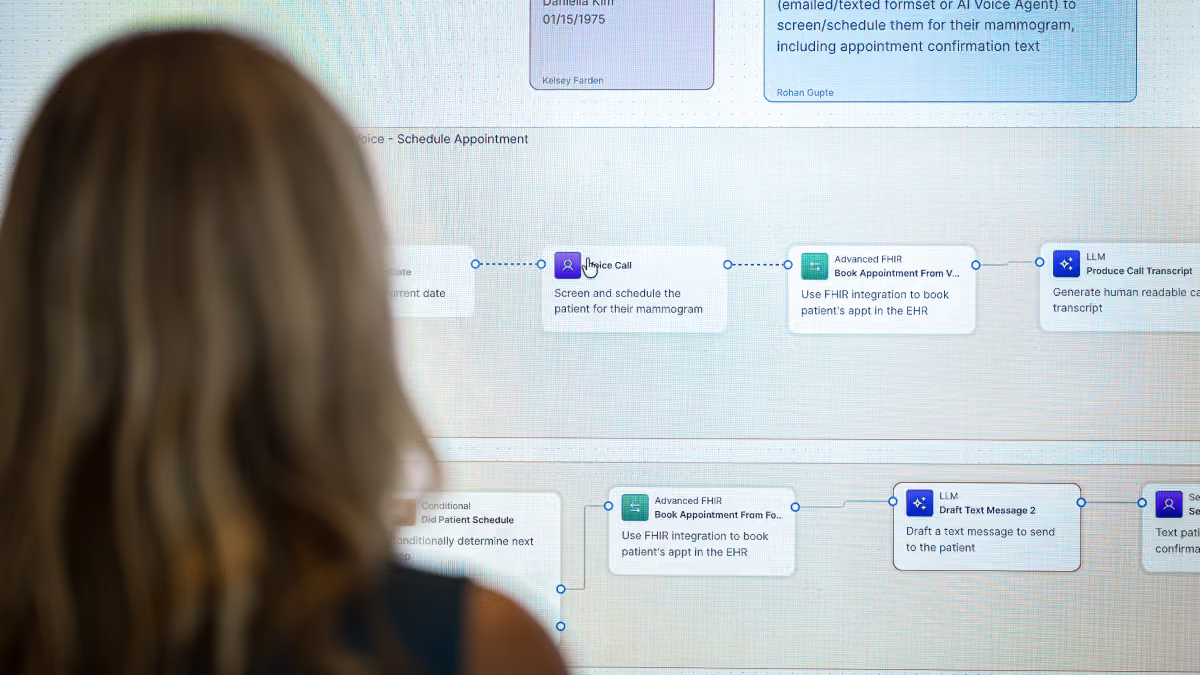
Karen O’Connor, Product Owner and Senior Project Manager at CommonSpirit Health, leads the AI initiative using Notable’s AI Flow Studio.
Her first piece of advice: Care management and patient access teams must stay aligned, starting with clearly defined AI goals.
Rather than replacing team members with AI, the organization leverages the technology to support high-impact outreach efforts. AI is built into contact center workflows, such as vaccination and chronic care management.
“When we talk about jobs that aren’t very fulfilling, cold-calling patients and hoping they answer is high on the list,” says O’Connor. “AI is relieving staff from that work.”
In transitions of care, timing is critical. Patients need to be scheduled for medication reconciliation with a nurse, followed by either a post-inpatient visit or an appointment with their primary care provider.
AI is helping patients navigate the important 14-day window after discharge by scheduling and providing educational resources. CommonSpirit is also prompting patients to make smarter, more cost-effective care decisions.
With potentially high treatment costs, missed opportunities for efficient patient care are often found in the ED. Because of its flexibility and real-time access, AI is reducing healthcare costs for ED patients. CommonSpirit deploys AI messaging to target patients who visited the ED with a preventable or potentially avoidable condition.
By asking patients via text or email why they chose the emergency department, the organization gathers insights at scale without having staff reach out one by one.
A local transition-of-care team follows up with high-risk or frequent ED utilizers.
CommonSpirit delivered more than 350,000 care gap outreaches in 2024, along with an additional 139,000 broadcast messages.
Broadcast messages are highly effective in improving patient care follow-through. This one-way communication is built into an AI flow and prompts action.
For example, when a patient requests the final refill on an active prescription, an AI broadcast message notifies them that a visit with their PCP is required for future refills. The message reminds patients to schedule an appointment before their next pick-up.
The refill program resulted in 91% of participants scheduling appointments after receiving the outreach messages. O’Connor ties the organization’s success to several key strategies:
Unlike broadcast messages, AI care gap outreaches are two-way communication. A flexible AI platform like Notable enables CommonSpirit to get creative with patient engagement, combining broadcast messages with care gap outreach for those who may need extra support.
CommonSpirit explored using community health workers, rather than social workers, to address maternal mental health, recognizing how often depression goes untreated.
AI outreach was designed to encourage more honest responses. Now, women can complete depression screenings privately before clinic visits.
An “urgent score” workflow triggers immediate alerts when a patient reports any non-zero response on a specific question that assesses self-harm risk. Critical alerts are reviewed and routed to the appropriate response team, including the community health worker.
If an appointment isn’t scheduled after three messages, the contact center steps in with outbound human calls. With multiple ways to reach patients, CommonSpirit is defining life-saving value beyond traditional ROI.
As more patients self-schedule appointments, the health system’s contact center handles fewer calls – with each avoided call saving an estimated six minutes of agent time.
Along with call volume, abandonment rates are equally measured; the organization found that AI reduces call abandonment caused by long wait times. In a high-turnover environment, stabilizing the workforce delivers meaningful, long-term value.
In the first year after launching AI workflows, the focus was on education and building trust, helping stakeholders understand how the tool was used and its organizational impact.
After the initial pilot campaign, adoption accelerated and leaders across the organization took notice: the increase in Medicare Annual Wellness Visits driven by AI outreach was a key contributor to improved revenue.
Other AI programs, such as those for child and adolescent well-care visits, are tied to internal quality metrics. Seventy-five percent of practices using Notable AI have met the expected performance threshold.
While the organization recognizes there is room for improvement, these practices are successfully meeting target benchmarks.
“Now I feel like Notable is really part of the organization,” says O’Connor. “It's not just an efficiency gain, it's a testament to how AI technology can truly transform patient outcomes.”
O’Connor continues to find motivation to move past roadblocks. “Don’t accept 'no' as the final answer,” she says. “A ‘no’ often means 'next opportunity.’ Find it. You only need one to start the cycle.”
For CommonSpirit, scaling AI is about finding a balance between people, technology, and results – using automation to extend outreach. And so far, this approach is working.